


The Knicks came back from a record 29-point deficit in the second half of Game 4 of the NBA Finals on Wednesday. It was an amazing offensive performance by the Knicks, and an amazing collapse by the Spurs. You have to have a partner for this kind of dance and the Spurs were all too willing to give the Knicks a chance to come back.
The scene
Wednesday, June 10th, 2026, will forever be remembered by NBA fans as the night that the San Antonio Spurs let go of a 27-point lead at half-time to lose the game by one point on a made tipped basket with 1.2 seconds left on the clock.
To set the scene further, NBA games are played in four quarters of 12 minutes each. The Spurs scored 41 points in the first quarter and 35 points in the second quarter. They proceeded to only score 30 points in both quarters of the second half.
But that’s not why they lost the game. A 30-point half with a 27-point lead at halftime should be more than enough to be able to win the game. The real challenge that the Spurs had is that they appeared to not be monitoring the right variable. And for that I’m going to suggest that every NBA team should have a version of the application I just built.
The shot clock
In the NBA each team gets a 24-second shot clock every time they get possession of the ball from the other team. If the team that has possession of the ball fails to make a shot or at least have the ball touch the rim in 24 seconds, they lose possession of the ball.
This means that in the 24 minutes of the second half, there were 60 24-second time periods available if each team was going to use the entire shot clock. New York, of course, was not incentivized to use the entire shot clock. They needed to try to score as quickly as possible so that they could maximize the number of possessions they had to be able to try to achieve their comeback. San Antonio, however, should have been very much incentivized to use as much of the shot clock as possible.
That said, the minimum number of possessions each team was guaranteed based on the shot clock was 30 possessions each.
Let’s run a purely mathematical version of this scenario that does not take into account the dynamics of an actual NBA Finals game, and also assume that each team maximizes a shot-clock driven strategy.
In this scenario, the Spurs take a shot clock violation with every single one of their possessions in the second half in order to slow the game down as much as possible. The Knicks take a 3-point shot within 12 seconds of their shot clock with every single one of their possession, and make 50% of those 3s. Shooting 50% on 3s taken within 12 seconds of the shot clock for 24 straight minutes is impossible, but we’re just laying down this hypothetical as a foundation here.
This impossibly successful half for the Knicks and equally impossibly disastrous half for the Spurs would result in the Knicks scoring 54 points in the second half, which means the Spurs would have needed to score just 28 points in second half to win the game. They scored 30, and they lost the game.
This not only means the Knicks scored better than the equivalent of 50% 3pt percentage at a blazing clip of a 3pt attempt every 12 seconds of their shot clock. It also means the Spurs gave them enough possessions to make the math work.
Dancer, meet dance partner.
The possession game
With a minimum of 30 possessions per half, not accounting for offensive rebounds, the Knicks needed to speed up the game in order to maximize their shot attempts. But a team can only speed up the game so much on their own. Taking a shot every 12 seconds of the shot clock is a blistering pace - the Knicks’ actual pace was 15 seconds in the first half and 16.7 seconds in the second half, based on play-by-play data from https://www.basketball-reference.com.
At their second half pace, the Knicks played fast enough to guarantee themselves 36 possessions, if San Antonio ran the clock every time on their side and didn’t grab any offensive rebounds.
But San Antonio’s pace in the second half was actually faster than New York’s, with an average of 16 seconds per possession. The team with a 27 point lead played faster than the team trying to come back from that deficit!
This allowed the Knicks to have 44 possessions in the second half, a blistering 47% more than their guaranteed 30 possessions and a significant 22% more than the 36 possessions they would have gotten if the Spurs completely milked the clock.
Real world solution
The math around this is not straightforward, because there are many variables in a real game versus the simplistic Excel-based model I used for the previous scenarios.
In real games, defenses do not let offenses just stand around and let the shot clock run out. In real games, shooting percentages vary drastically based on the quality of the shot. In real games, running the same play (running out the shot clock) repeatedly gives the opposing team a much better chance at breaking up said play.
But that does not negate the simple fact that San Antonio conceded the single most important variable they could have controlled in the second half, which is the number of possessions New York had to attempt to score. The numbers are clear: San Antonio’s poor clock management allowed New York almost a quarter more bites at the scoring apple. With a 27-point lead, San Antonio should have been in complete control of that and instead they voluntarily relinquished it.
I put together a simple application that accounts for some key variables and would have shown the Spurs that at some point in the third quarter, the combination of their massive lead and the amount of time left on the clock meant that all they had to do to win the game was play solid defense and not take a shot inside 22 seconds of the shot clock to win. With that strategy, the Spurs could have scored at the rate of the Utah Jazz in Game 3 of the 1998 Finals (0.69 points per possession for a total of 54 points in the game), and withstood a scoring barrage from the Knicks at the 1.4 points per possession rate of the Celtics who scored 148 points in the 1985 Finals.
Here is how the application works:
The user can adjust the following variables for each team
Scoring rate, which is the expected points per possession. When monitoring a game in real life, this can be updated to reflect the actual team’s scoring rate during the game
Possession length, which is the average amount of time each team holds on to the ball before losing possession, either because they scored, turned the ball over or had a shot clock violation
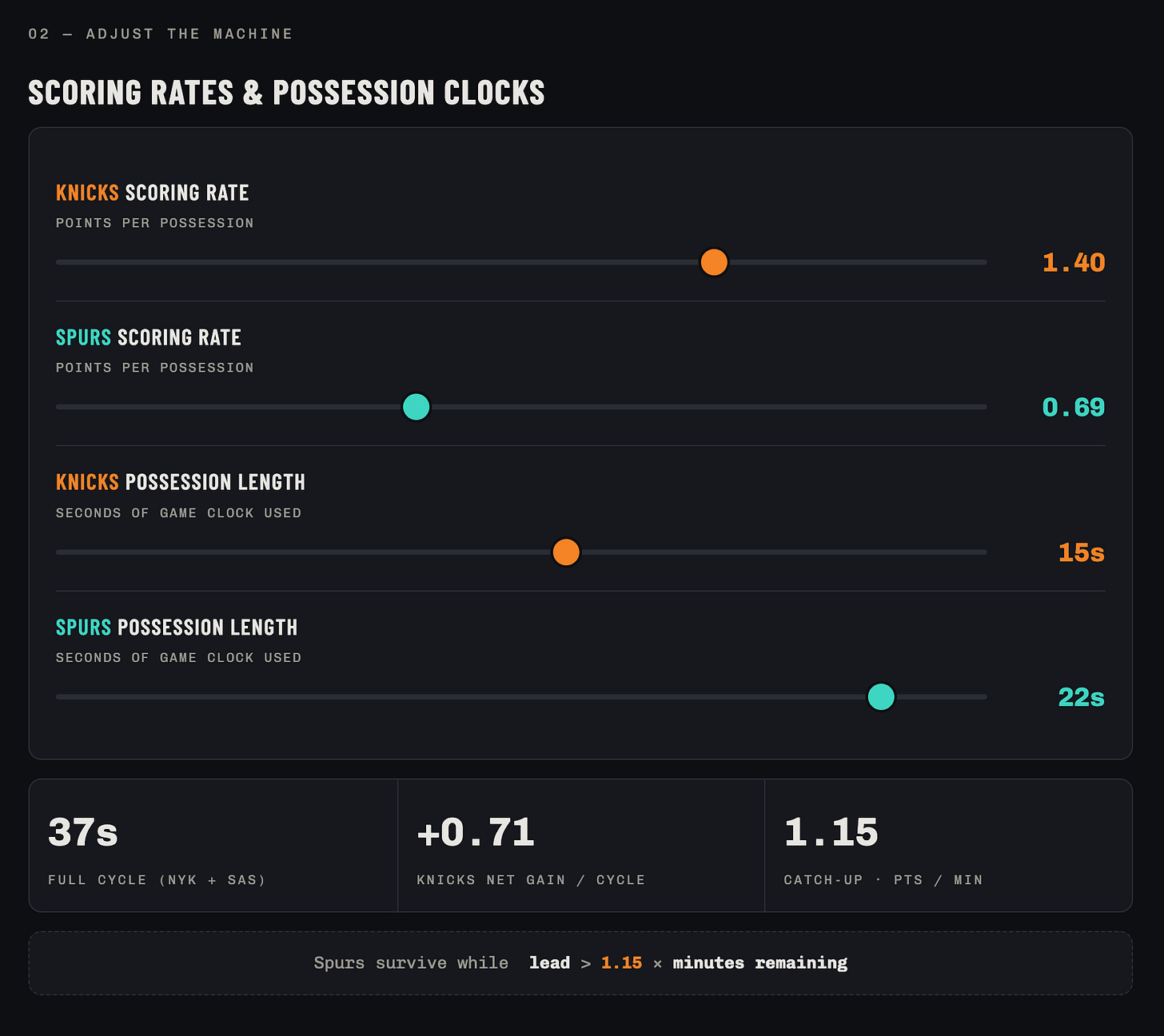
Based on those variables, the application calculates the following values in real-time:
The full possession cycle for both teams
The projected net gain from the team who is behind based on the full cycle
The catch-up rate, which is how many points the trailing team makes up per game minute
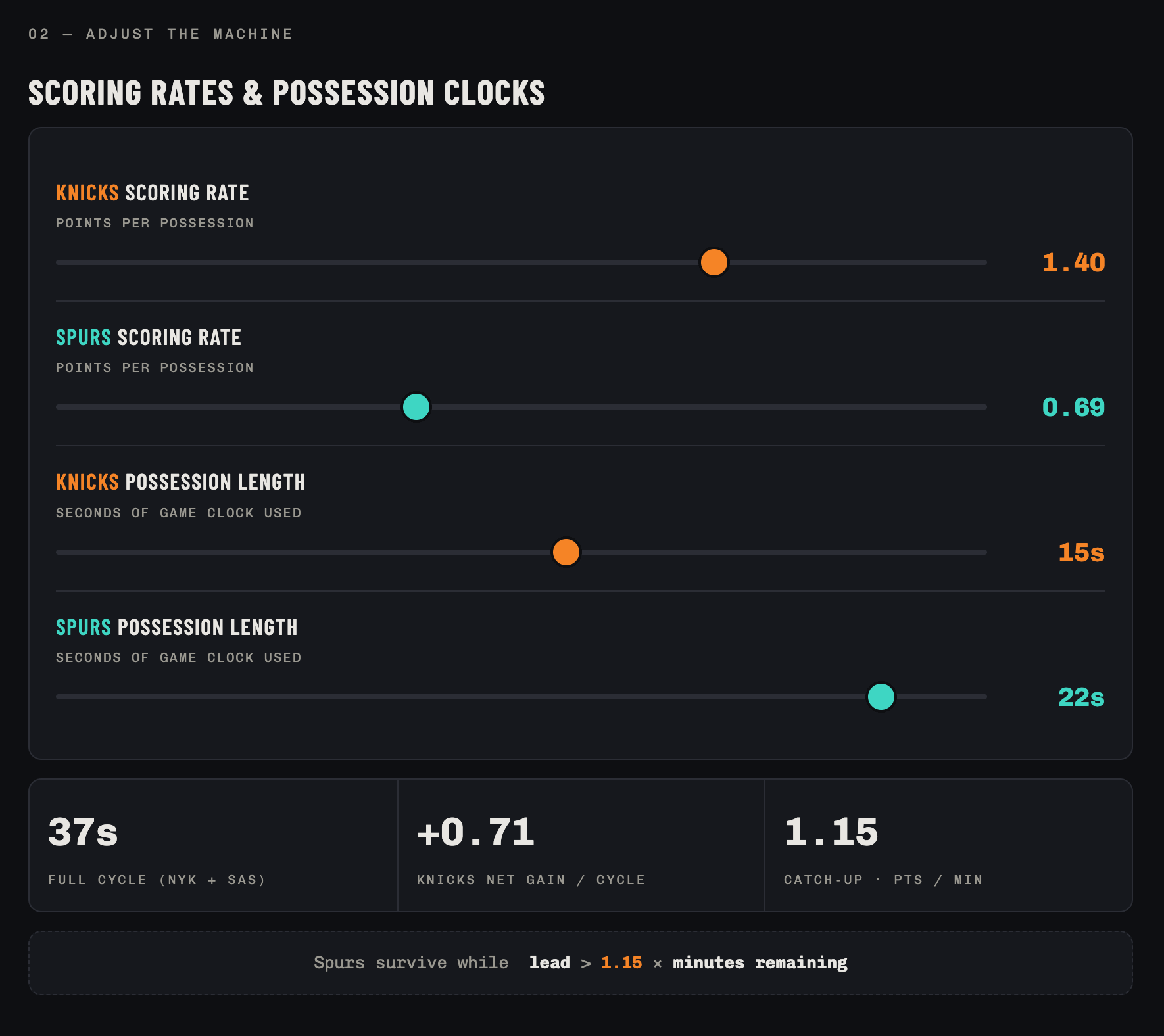
This allows the application to calculate what the lead needs to be in order for the leading team to win with a very low scoring rate based on the number of minutes remaining in the game
Which leads us to being able to produce this interesting graph:
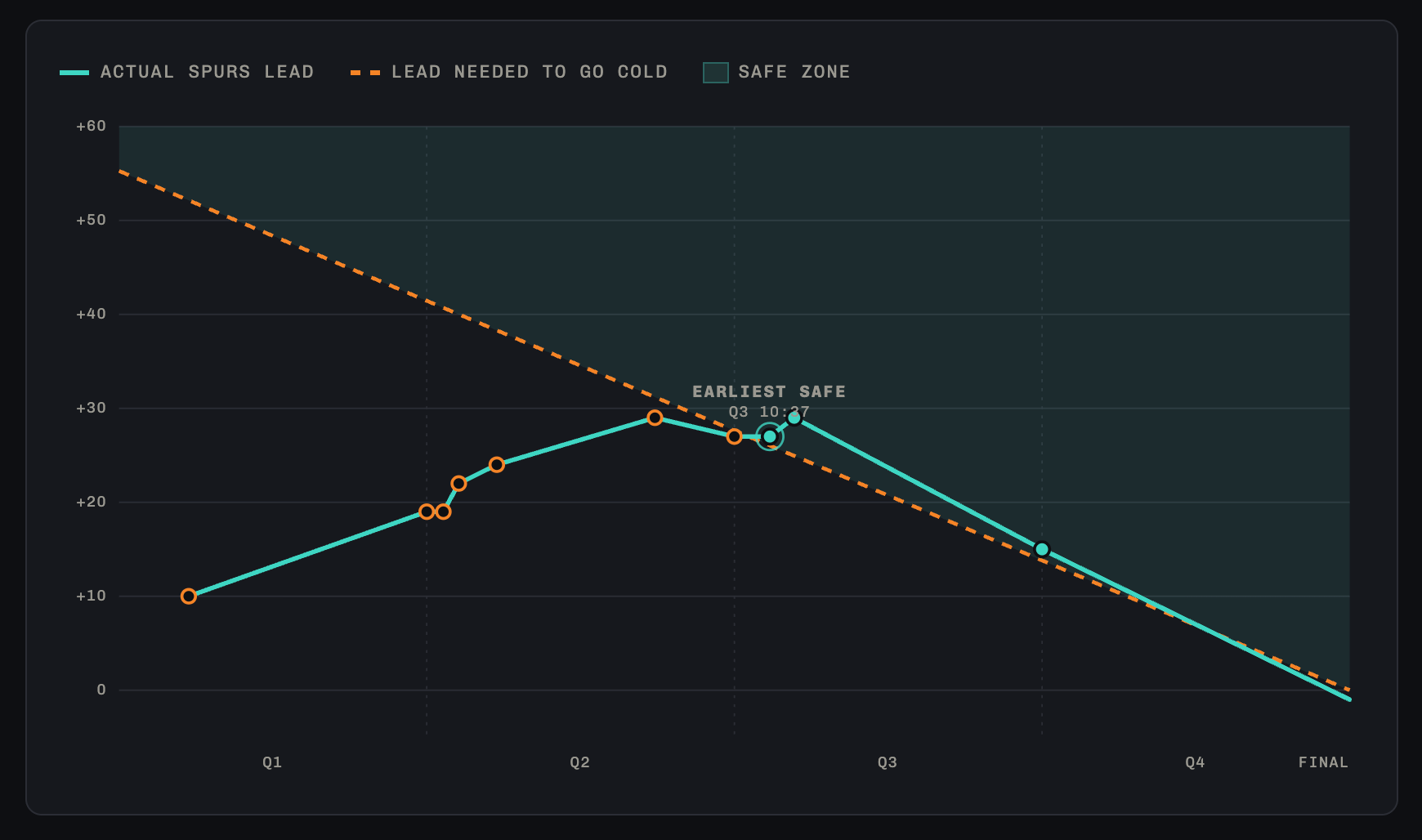
With actual play-by-play data from https://www.basketball-reference.com, we can see that the Spurs’ scoring could have fallen to all-time lows in the third quarter, after Wemby gave them a 27-point lead with 22.6 minutes left in the game, and they could have still won the game if they used up 22 seconds of the shot clock every time they had the ball.
The right analytics
Many have criticized the Spurs for staying with their 3-point shot, even when their shooting percentage plummeted from their hot first half at 53.8% to 17.6% in the second half.
But the real issue is that they combined poor 3-point (and overall) shooting with extremely poor clock management.
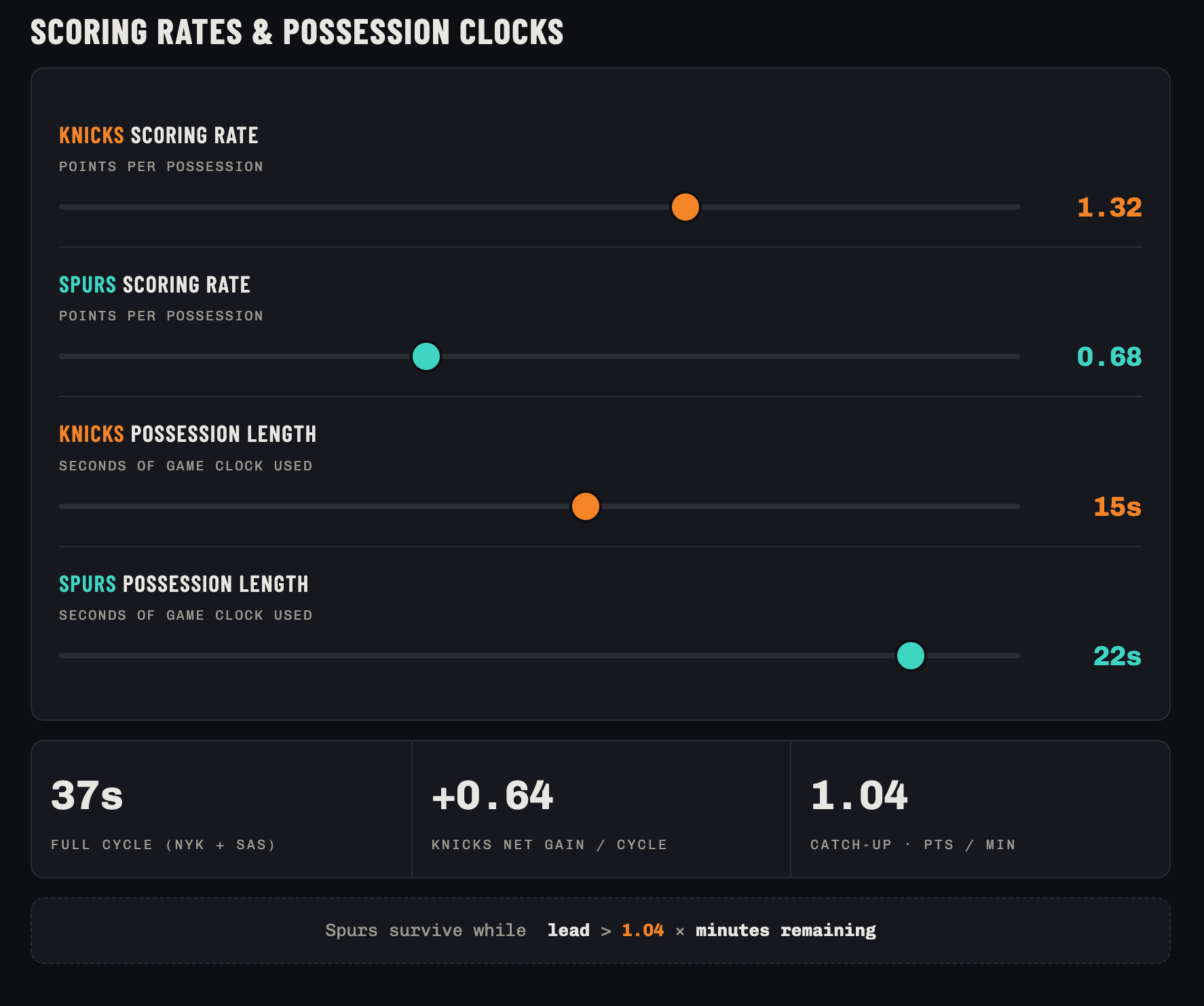
With the real points per possession numbers for the second half for the red-hot Knicks and the ice-cold Spurs, we have 1.32 points per possession for New York and 0.68 points per possession for San Antonio. Near records for both. Even then, the application shows us that the Spurs could have held on for the win if they used 22 seconds of the shot clock instead of the 16 they actually used:
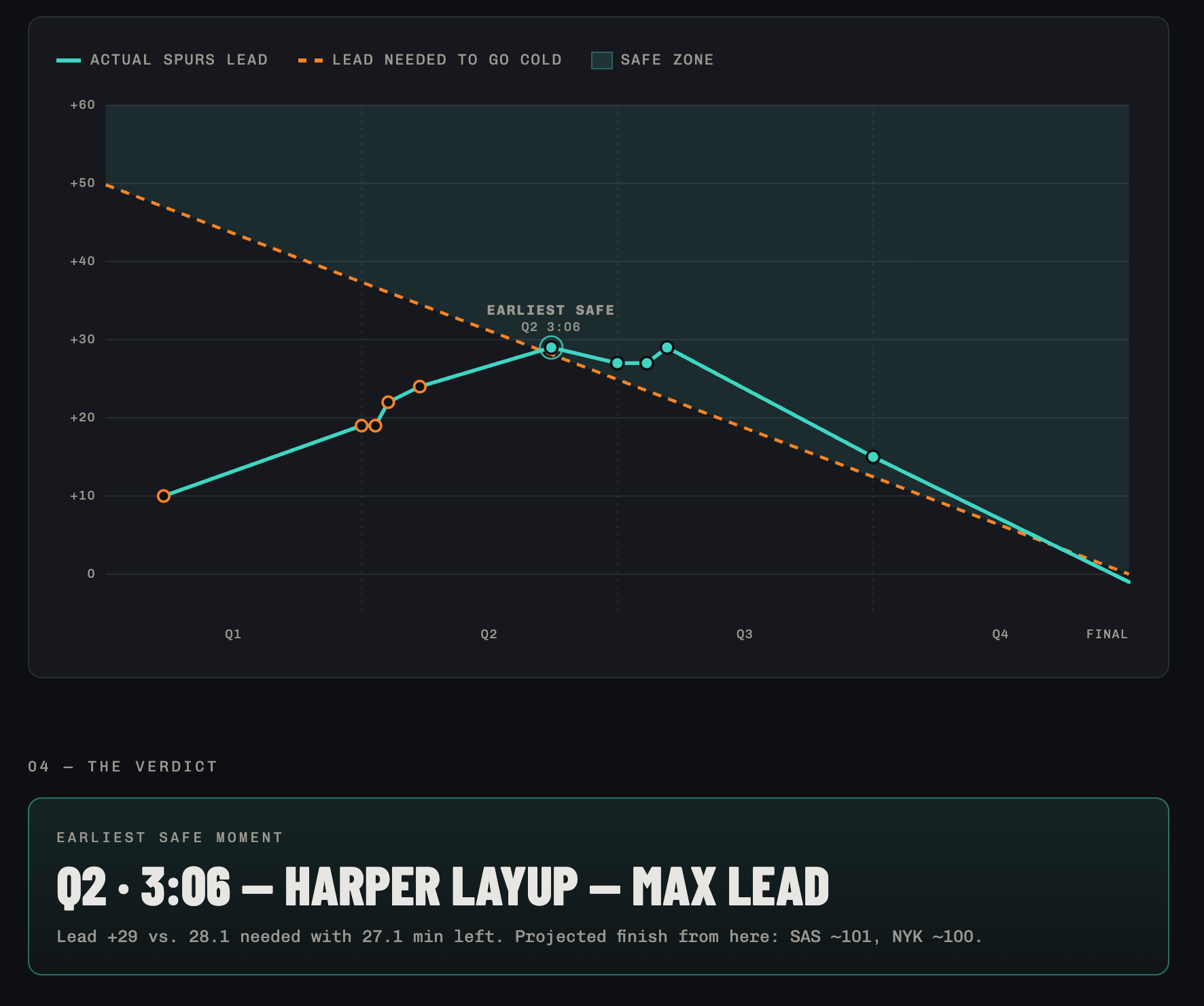
The problem with the Spurs in Game 4 isn’t that they took the shots the analytics told them to take, the problem is that they didn’t effectively monitor and adjust to another key analytic piece of data, which afforded the Knicks additional possessions to execute their historical comeback.
Having a tool to monitor a metric does not mean that a young, inexperienced team like the Spurs would necessarily be able to implement the recommendations. Game 4 was a very high-stakes game in one of the most hostile stadiums in the NBA at MSG. But both the players and the coaching staff would have benefited from having a constant reminder that they never needed to cede control of the key variable of length of possession, even as the Knicks shooting improved dramatically and their own shooting percentage tanked. Having the re-assurance that the shot clock math was actually working against the Knicks could have helped the Spurs steady themselves and weather the storm.
Wrong possession strategy, down to the end
San Antonio’s last play is emblematic of their game clock management issues.
De’Aaron Fox grabs a defensive rebound and leads the fast break. He has OG Anunoby trailing him. There is 11 seconds left in the game. The shot clock is off. Fox can either keep his dribble and try to run the clock out, or wait until the Knicks foul him and go to the free throw line for a chance to put the game away.
Instead, he chooses to challenge OG at the rim with a layup and gets blocked. He took 3 seconds off the game clock, came up empty and left New York with 10 seconds to make the winning basket.
The Knicks played great offense in the second half. The Spurs did not. They did not need to. They just needed to not gift the Knicks all these additional possessions, including that very last one.
The gap between having the shot clock projection information and acting on it under pressure at MSG is a coaching problem, not an analytics one.
I came to gloat. Knicks is 5 just like I predicted. 🧡 💙 Skies Forever. 🗽 Shout-out to coach Johnson, what he did wasn't easy.
This is a great read. I think if you wrote a post for every unforced error the Spurs committed on Wednesday you'd have more than enough to fill your content calendar through the off-season.